

From Millimetres to Microns: Hysteresis Compensation of a Cable-Driven Continuum Surgical Robot
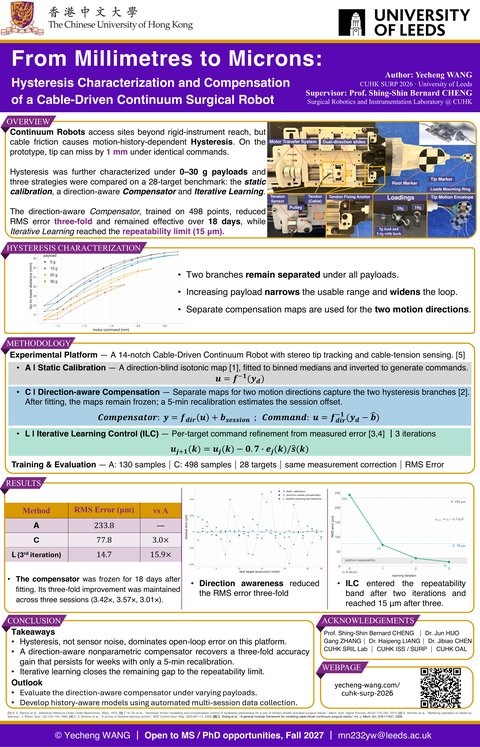
Cable hysteresis was the dominant error source; compensating it cut tip error 3.0× (234 → 78 µm), and an iterative learning layer brought it to ~15 µm.
I rebuilt a 14-notch tendon-driven continuum surgical robot with stereo tip tracking and cable-tension sensing, and identified path-dependent cable hysteresis as the dominant error source. I then designed a data-driven hysteresis compensator and a P-type iterative learning controller for the 0.25 s vision latency, and showed that tip loading widens the hysteresis loop, contradicting a friction-only assumption. The compensator was validated under a preregistered protocol on a sealed multi-target benchmark; the learning layer then approached the platform’s repeatability limit.